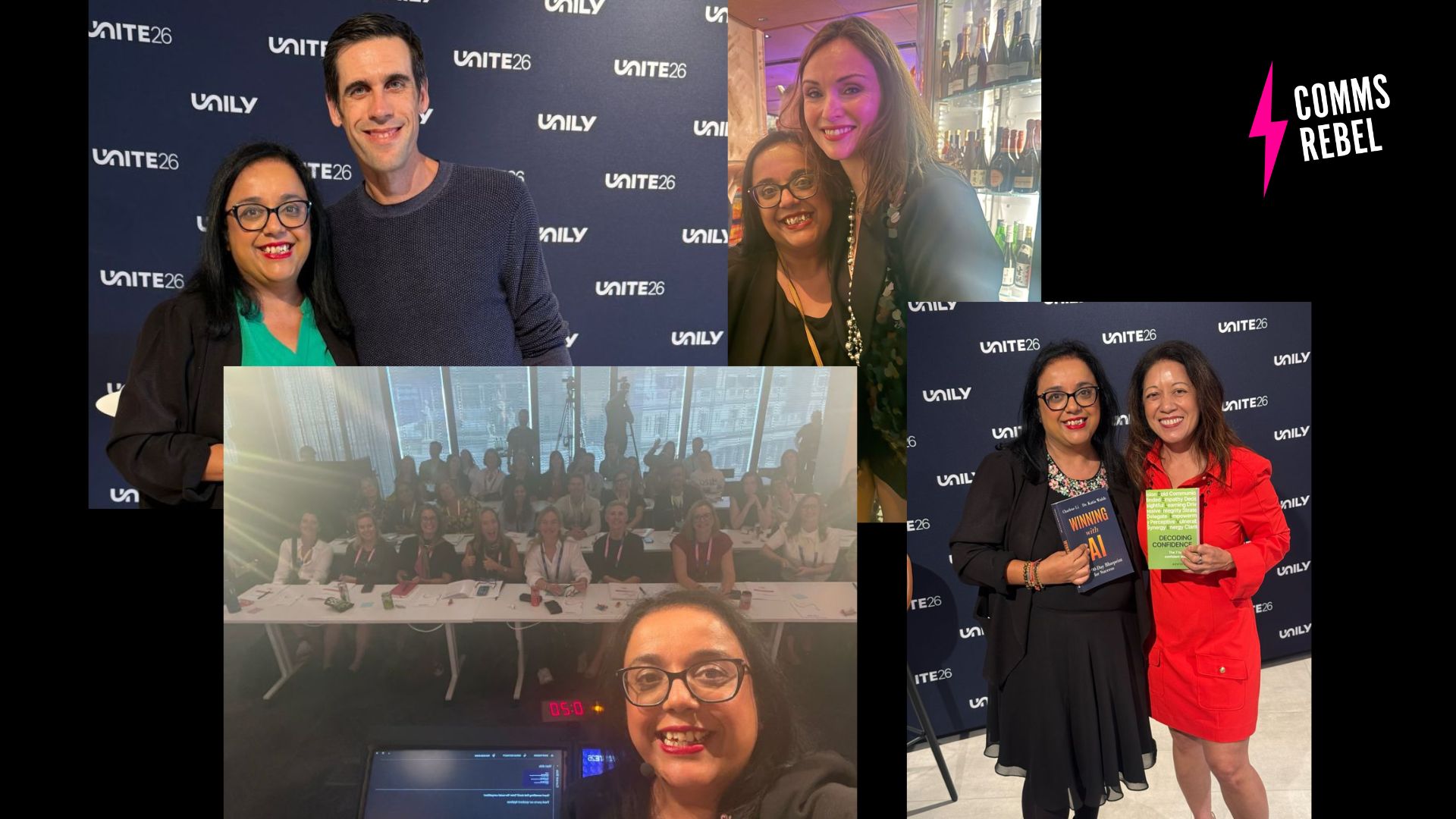
A huge well done to the team at Unily for hosting yet another brilliant Unite event.
It’s genuinely one of my favourite events of the year. Not only is the content always strong, but the conversations around the edges make events like this so valuable to me.
The quick chats over coffee and between sessions and the “is it just me, or…?” moments. These tell you far more about what people are really experiencing than any trend report ever could.
This year, there were a few themes that came up again and again. What struck me most was that none of them were particularly new. But they all felt more heightened.
Here are five key themes I took away from the conversations I had behind the scenes.
1. Everyone is juggling far too much
Internal communication professionals have always been brilliant jugglers.
We’re often balancing campaigns, leadership requests, change programmes, channels, employee listening, crisis comms, events and the inevitable “can you just…” request that lands at 4.45pm.
But this year, the pressure felt different – more intense.
Almost everyone I spoke to seemed to be managing 101 things at once. And that’s interesting when you consider how much we’ve been told that AI is going to save us time.
AI absolutely has the potential to make parts of our work quicker. I use it, I advocate for using it in a considered way, and I think there are huge opportunities for our profession.
But faster tools don’t automatically create more capacity.
If the time we save is simply filled with more work, more requests and higher expectations, we haven’t really solved anything.
We need to have a much broader conversation about priorities, boundaries and what good internal communication actually requires.
Technology can help us work faster. It can’t, however, decide what deserves our attention.
2. Line manager communication is still causing challenges
I don’t think this one is a huge surprise. Line manager communication is still one of the biggest challenges for internal comms teams to engage them in the work we do.
A suggestion I shared was to think more carefully about communication preferences. Not every manager wants to receive information in the same way.
Some want the detail. Some want three bullet points and the action they need to take. Some want the opportunity to ask questions. Others want to understand the bigger picture before they feel confident speaking to their teams.
If we want managers to communicate differently, we need to stop treating them as one homogeneous group and start personalising our approach. That alone can make a huge difference.
3. People want the human back
Unsurprisingly, AI featured heavily in conversations.
But what I found much more interesting was that people weren’t only talking about what AI could do.
They were talking about what they didn’t want to lose.
Human connection.
As more of our work becomes automated, streamlined, and digitally enabled, the organisations that stand out will be the ones that still know how to create genuine human connection.
For me, this is where internal communication has a huge opportunity.
AI can help us with efficiency. It can help us analyse information, generate ideas and speed up processes. However, empathy, trust, judgement and connection are still very much human skills that we need in the workplace.
4. Energy is becoming a workplace issue
The intensity and pace of work are taking their toll, and people are struggling with their energy.
We are heading towards the end of the year, so some of that is to be expected, but almost everyone I spoke to was feeling a strong sense of fatigue.
Many people are trying to keep up while appearing completely fine on the surface.
Energy is one of the things we don’t talk about enough at work. It’s such an important area – I even have an entire chapter dedicated to this very topic in my book, Decoding Confidence.
We talk about productivity, performance, engagement, resilience and so on, but none of these things are sustainable if people are permanently running on empty.
Sometimes the most productive thing you can do is stop.
Sometimes good leadership means removing something rather than adding something else.
Sometimes protecting your energy is the most important boundary you can create.
5. Comms is still being excluded from conversations it should be in
This was probably the frustration I heard most clearly.
There are still internal comms professionals discovering important decisions after they’ve already been made.
- A restructure has been agreed.
- A transformation programme is underway.
- A major organisational change is happening.
And then somebody calls comms and says: “Can you help us communicate this?”
I understand the frustrations all too well.
So, how can we change it? The advice I gave to a few people was this: executive leaders broadly care about three things.
- How to reduce risk
- How to make money
- How to save money
If we want their attention, we need to connect our work to those things.
Instead of only talking about engagement scores, channels or communication plans, show leaders what happens when communication goes wrong.
Show them the cost of mistrust, the productivity impact of confused employees, and how poor communication slows change.
If you speak in a language that execs understand, they will pay attention.
Do these challenges sound familiar?
If some of these challenges sound familiar – whether it’s getting leaders to listen, engaging line managers, navigating change or strengthening your internal comms approach – this is exactly the kind of work we support organisations with at CommsRebel.
We help internal communication teams build stronger strategies, influence leaders and create communication that genuinely connects with people.
If you’d like to explore how we could support your organisation, let’s have a chat.