

For many people, Sunday evenings come with a little dread. That all too familiar knot in the stomach. The racing thoughts about the week ahead. The sudden urge to check emails or mentally rehearse conversations that haven’t even happened yet.
The so-called Sunday scaries are incredibly common, particularly for people in high-pressure roles, caring professions or environments where boundaries are blurred, and expectations feel constant.
At CommsRebel, this issue comes up regularly in coaching conversations. And while the causes vary, workload, lack of clarity, comparison, and poor boundaries, the impact is often the same. Energy drains before the week has even begun.
The good news is that while Sunday scaries may feel overwhelming, there are practical ways to reduce their grip. None of them are revolutionary. But, they can make a meaningful difference.
Why Sunday Scaries Happen in the First Place
Sunday scaries are rarely about Sunday itself. They are usually a response to what Monday represents.
This could be unfinished tasks, unclear priorities or difficult relationships. That sense of being behind before the week starts. Add in constant connectivity and social comparison, and it is no surprise that anxiety creeps in.
The key is not to eliminate stress altogether. As much as we would love for that to happen, it is unrealistic. Instead, it is about regaining a sense of control, perspective and self-compassion.
Here are five practical techniques that CommsRebel often shares with coachees to help reset before the week ahead.
1. Use the Eisenhower Matrix to Create Clarity
When everything feels urgent, nothing really is.
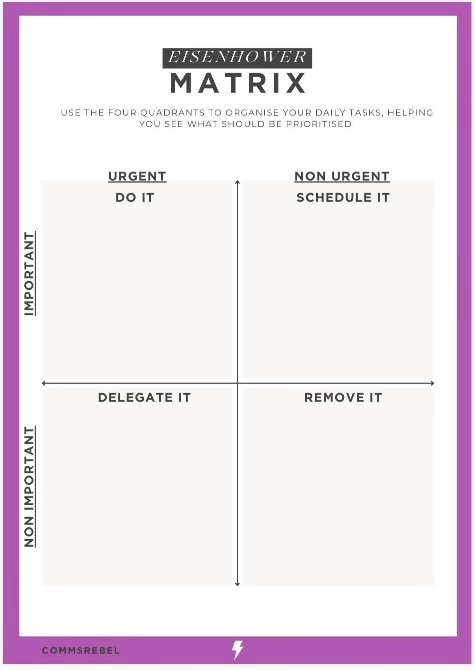
A simple but powerful place to start is the Eisenhower Matrix. This is a four-box framework that helps people separate tasks by urgency and importance.
The boxes are:
- Urgent and important
- Important but not urgent
- Urgent but not important
- Not urgent and not important
Writing tasks down and plotting them visually can be pretty revealing. Many people discover they are carrying far more than they need to.
If everything ends up in the urgent and important box, burnout is not far behind.
This exercise often highlights tasks that can be:
- delegated
- scheduled properly
- deprioritised
- or removed altogether
Clarity reduces anxiety. And clarity starts with seeing what actually needs attention, rather than reacting to everything at once.
2. Look for Glimmers, Not Just Stressors
When work feels heavy, the brain has a habit of filtering out anything positive.
This is where glimmers come in.
Glimmers are small moments that bring a sense of ease or joy. They are not big wins or promotions. They are everyday things that often go unnoticed.
A kind message from a colleague. A good cup of coffee. A walk at lunchtime. A piece of positive feedback. A moment of laughter in a meeting.
Taking time to write these down, even briefly, helps rebalance perspective. It’s a nice way to remind ourselves of the good things that we can sometimes dismiss.
3. Plan Something Enjoyable for Monday
One reason Sunday scaries hit hard is that Monday feels like a day we just need to get through – enduring it rather than anticipating it.
Adding something joyful to a Monday can help to shift that narrative.
This does not need to be elaborate. It could be:
- a yoga or exercise class after work
- a lunchtime walk with a friend
- a favourite meal planned for the evening
- a cinema trip or creative activity
The aim is to give the nervous system something to look forward to, not just something to get through.
Joy does not need to wait until the weekend.
4. Reduce Comparison and Digital Overload
Scrolling social media on a Sunday evening can quietly fuel anxiety.
Seeing other people’s highlights, career updates or curated lives can trigger comparison, even when logically it makes no sense.
If you consistently feel worse after scrolling, switch off your phone.
A full digital detox may not be realistic during the working week, but Sunday can become a gentler boundary day. Fewer notifications. More intentional use. Less mindless scrolling.
Comparison drains energy. Stepping away from it can be an act of self-care.
5. Get Outside and Move, Even Briefly
Movement and fresh air are two of the most underrated tools for managing stress and giving an instant dopamine boost.
A short walk. A trip to a local coffee shop. Time near water. Even five or ten minutes outside can regulate the nervous system and lift mood.
It is not about fitness goals or productivity. It is about giving the body a signal that it is safe to slow down.
Often, clarity follows movement.
Small Shifts, Real Impact
None of these techniques are groundbreaking. But sometimes we all need a reminder that the only thing we can control in this life is how we react to situations and what we can do to help ourselves.
The alternative is staying stuck in a cycle of misery. And that helps no one.
If Sunday scaries are becoming a regular feature, it may be a sign that something deeper needs attention. Boundaries, workload, confidence or clarity. Support can make all the difference.
If you need support from CommsRebel in working through any of this, get in touch for more information about coaching with Advita or book in for a free discovery call.
P.S If you enjoyed this post, you may find 5 ways to stop worrying about what others think helpful reading.